
What Is a Pixel?
A pixel — short for picture element — is the smallest piece of a digital image that can be given its own colour. It carries a value, not a size.
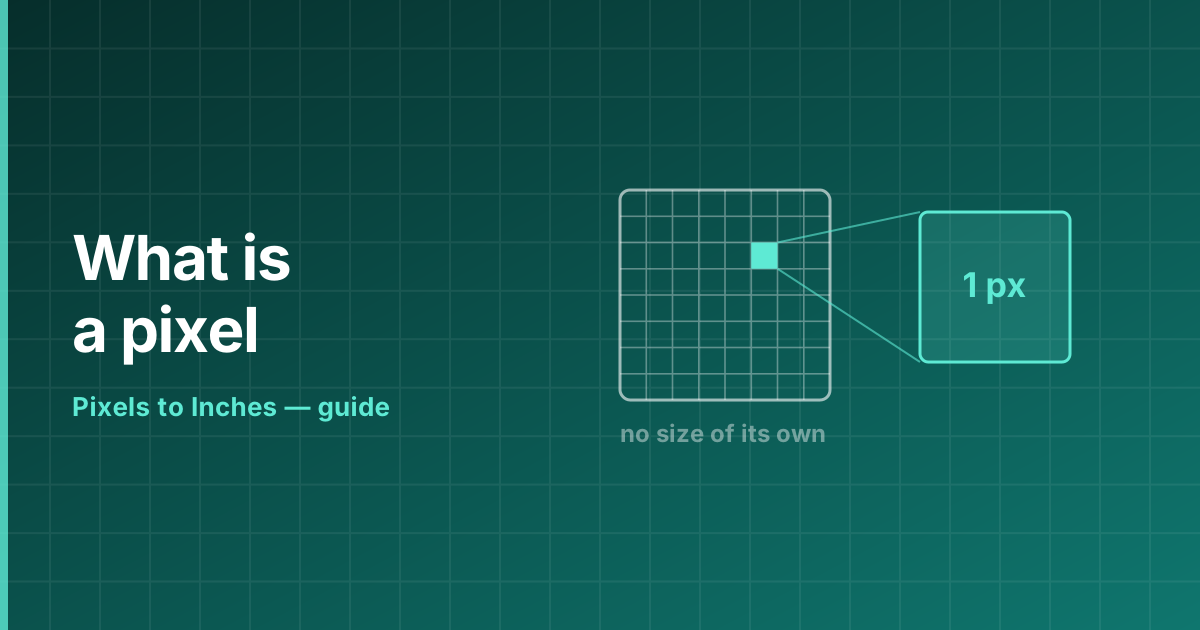
What a pixel is
In an image file, a pixel is one colour sample: three numbers for red, green and blue, sometimes a fourth for transparency. A 1920 × 1080 image holds 2,073,600 of them arranged in a grid.
On a display, a pixel is a physical cluster of subpixels — usually one red, one green and one blue — that together produce a single point of colour. Holding a magnifier to a screen shows the stripes directly.
How big is a pixel?
The size of a pixel is not fixed. Pixel sizes are set by the density of the device showing them: one pixel measures 1 ÷ PPI inches.
On a 96 PPI monitor a pixel is 0.0104 inches, about a quarter of a millimetre. On a 460 PPI phone it is 0.0022 inches. On a stadium screen a single pixel can be several centimetres across.
Pixels, resolution and megapixels
Resolution is a pixel count — 4000 × 3000. Megapixels are that count divided by a million, so 4000 × 3000 is 12 megapixels. Neither says anything about physical size until a density is chosen.
That relationship is the entire basis of pixel-to-inch conversion: inches = pixels ÷ PPI.
Frequently asked questions
What size is one pixel on a 300 DPI print?
0.0033 inches — below what the eye separates at reading distance, which is why 300 DPI prints look continuous. At 150 DPI it doubles to 0.0067 inches and starts to show.
What is pixel size in mm?
Divide 25.4 by the density. At 96 PPI a pixel is 0.265 mm; at 300 DPI it is 0.085 mm.
Are pixels square?
Almost always, in modern formats. Some legacy video standards used non-square pixels, which is why old footage can look horizontally stretched if the aspect flag is ignored.